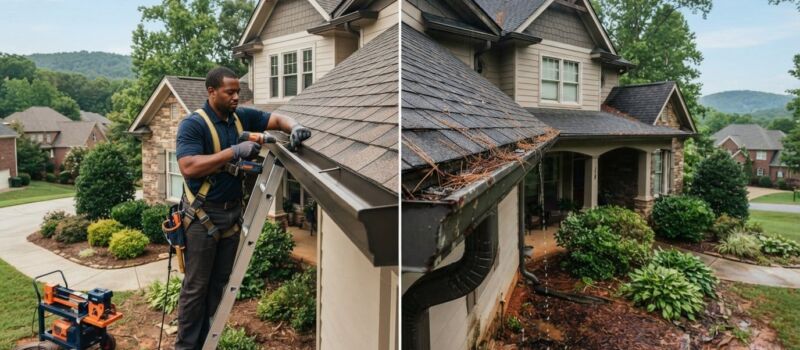
Did you know that the most stressful part of a hailstorm often begins after the clouds have cleared? Once the ice stops falling, many homeowners find themselves caught between the fear of hidden leaks and the anxiety of being pressured by “storm chasers” looking for a quick payout. It’s a vulnerable position to be in, especially when you’re simply trying to protect your family’s safety and your property’s value. If you’re wondering how to spot hail damage on your roof from the ground without the risk of a ladder climb, you’re already taking the smartest step toward securing your home.
We understand that home maintenance feels increasingly complex, particularly with recent spikes in material costs across the industry. You deserve a clear path forward that doesn’t involve high-pressure sales tactics. This guide will teach you how to identify expert-level signs of damage from the safety of your lawn using our proprietary ground-level inspection techniques. We’ll walk you through a methodical process to find “collateral damage” on your gutters, vents, and siding. This will give you the confidence to decide whether to initiate an insurance claim or wait for the next season with total peace of mind.
Key Takeaways
- Learn why staying on the ground is the safest and most effective first step for evaluating your home’s condition after a major storm.
- Discover how to spot hail damage on your roof from the ground by identifying subtle “splatter” marks and dents in soft metals like gutters and window trim.
- Identify the “canary in the coal mine” signs, such as shingle granules in your downspouts, that indicate your roof’s protective layer is compromised.
- Follow our 5-step documentation checklist to gather the wide-angle photos and storm logs needed for a smooth administrative process.
- Apply the “Rule of Three” to gain the confidence to know exactly when to request a professional integrity-based inspection from a trusted local expert.
Why Ground-Level Inspection is Your First Line of Defense After a Storm
Have you ever stepped outside after a severe storm and felt that immediate pang of worry while looking up at your shingles? It’s a common feeling for homeowners in the Tennessee Valley, where weather can turn aggressive in an instant. Understanding what hail is and how it interacts with your home’s specific orientation is the first step in protecting your investment. While your first instinct might be to grab a ladder, the safest and most effective way to begin is by keeping your feet firmly on the turf. Knowing how to spot hail damage on your roof from the ground allows you to evaluate the situation without putting yourself at unnecessary risk.
In North Alabama, our storm patterns typically move from the west or southwest, meaning hail often strikes one or two sides of a home with much greater force than the others. By identifying which side of your house bore the brunt of the weather, you can narrow your focus. Spotting these issues early is critical. If damaged shingles are left unaddressed, they eventually allow moisture to migrate into your attic and walls. Over several seasons, this moisture can lead to wood rot and even contribute to foundation issues if your home’s drainage is compromised. A quick walk around your lawn today can save you from a major structural headache next year.
The Risks of Post-Storm Roof Climbing
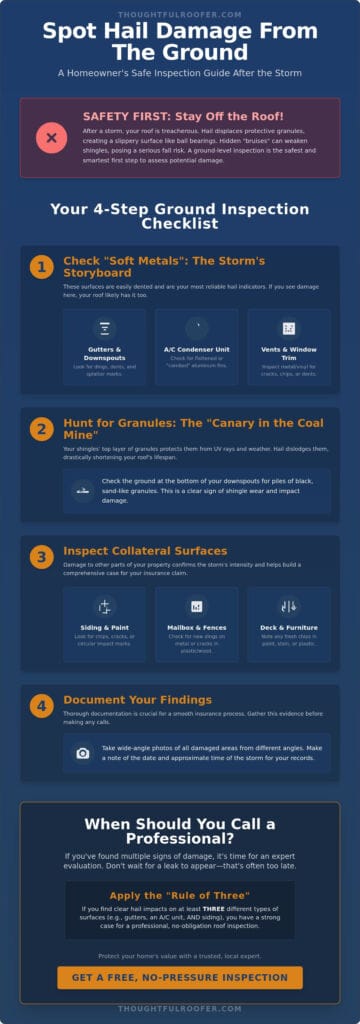
After a significant weather event in the Huntsville area, your roof’s surface is often more treacherous than it appears. Hail impacts don’t just leave dents; they displace the protective granules that provide your shingles with UV protection and traction. These loose granules act like ball bearings under your shoes, making a slip or fall highly likely. Additionally, shingles can suffer from “bruising,” which are soft spots where the internal fiberglass mat has fractured. Stepping on these weakened areas can cause further damage or even lead to a structural failure if the decking underneath was already aged. Professional storm damage roof repair experts utilize specialized safety harnesses and high-traction footwear because they know how unpredictable a damaged roof can be.
What Ground-Level Signs Actually Tell You
Think of your yard and lower-level fixtures as the “canary in the coal mine” for your roof’s health. If the hail was strong enough to dent a heavy-duty metal downspout or chip the paint on your siding, it almost certainly had enough force to compromise your shingles. These ground signs serve as reliable proxies for what an insurance adjuster will look for during a formal inspection. It’s also vital to remember that “no visible leaks” doesn’t mean “no damage.” Modern roofing systems are designed to shed water even when damaged, but a compromised shingle has a significantly shorter lifespan. By identifying high-probability areas from the safety of your lawn, you gather the preliminary evidence needed to advocate for your home’s long-term security. For those in the Denver area, you can discover Royalty Construction for professional assistance with exterior restoration and storm damage assessments.
Checking the Soft Metals: Reliable Ground-Level Hail Indicators
Why do we look at metal fixtures first? While asphalt shingles are designed to be resilient, the “soft metals” around your home act like a physical record of a storm’s intensity. If you’re learning how to spot hail damage on your roof from the ground, these surfaces are your most reliable witnesses. Because materials like aluminum and copper are thinner and more malleable than roofing products, they record the size and density of hailstones with high precision. If a hailstone was strong enough to dent a metal downspout, it likely had enough force to bruise the shingles directly above it.
Your air conditioning condenser is another vital piece of evidence. The thin aluminum fins on these units are incredibly fragile. If you notice areas where the fins look flattened, “combed” over, or crushed, you’re looking at clear evidence of heavy impact. You should also check secondary surfaces like your mailbox, plastic lawn furniture, or even your grill cover. If a plastic chair has a fresh crack or a metal mailbox shows new dings, you can be certain those same stones were hitting your roof with the same velocity. Consistency across these different surfaces builds a strong case for an insurance claim.
While your roof is the priority, hail often leaves its mark on vehicles as well. For those dealing with automotive pockmarks, you can visit Five Star Dent Removal to explore expert paintless dent repair services.
Beyond cosmetic dent repair, ensuring your car’s mechanical systems are functioning correctly is also vital; for those with Japanese models, check out Speedy Roo Motorsports & Repair Inc for expert maintenance and repair services.
Gutters and Downspouts as Evidence
Walk along your home’s perimeter and examine the downspouts closely, particularly at eye level where the light hits the metal directly. Small, circular indentations are the classic “pockmarks” left by hail. While seamless gutters are built for durability, their long, smooth profiles make even minor deformations stand out. You should also inspect the area where your downspouts empty onto the splash block or grass. A heavy accumulation of black, sand-like mineral granules suggests your shingles are shedding their protective coating. This loss of granules is a serious issue that leaves the underlying asphalt vulnerable to UV degradation and leaks.
Window Screens and Soft Trim
Window wraps, garage door trim, and screens often show the first signs of “splatter marks.” These occur when hail knocks off the layer of oxidation or dust on a surface, leaving a cleaner, shinier spot behind. Check your window screens for small tears or “bruises” in the mesh; these often look like dark, distorted spots when viewed from an angle. If the damage is hard to see, try using a flashlight during the early evening. By shining the light at a sharp angle against the metal trim, you can reveal subtle deformations and dents that are invisible in direct midday sun. If you discover multiple dings across these soft metals, it’s a wise move to reach out for a professional evaluation to ensure your home’s protective envelope hasn’t been breached.
Identifying Shingle Debris and Siding Damage Without a Ladder
Have you noticed strange “sand” or black pebbles accumulating in your yard or on your driveway after a storm? This isn’t just dirt. It’s often the first sign that your roof’s protective layer is literally washing away. Learning how to spot hail damage on your roof from the ground involves looking at what falls off the roof just as much as what stays on it. When hailstones strike asphalt shingles, they act like tiny hammers that knock loose the mineral granules. If you see these granules gathering in your yard, it’s a clear signal that the storm has compromised your home’s primary line of defense.
Siding damage often mirrors what’s happening on your roof. Vinyl siding is particularly prone to “half-moon” cracks or chips, especially on the side of the house that faced the wind. Wood siding might show dents or areas where the paint has been stripped away, leaving the raw wood exposed to the elements. You should also look for the “shadow effect” from the curb. These are dark, circular spots on the roof surface. While they might look like simple dirt from a distance, they are often areas where hail has knocked off the granules, exposing the dark asphalt underneath. If you see “missing teeth” in your roof’s profile, it means entire shingles or tabs have been knocked loose or blown away by the wind-hail combination.
The Granule Loss Warning
Think of shingle granules as the “sunscreen” for your roof. They protect the underlying asphalt from the sun’s harsh UV rays and provide essential fire resistance. While some granule loss is a normal part of the aging process, a sudden surge after a storm indicates a significant loss of lifespan for your roofing system. You can distinguish storm damage by looking for localized piles of granules rather than an even, thin layer. In the context of storm damage, granule loss is the primary cause of premature roof repair needs.
Visualizing the Roof Surface from the Lawn
A simple pair of binoculars can be your best friend when assessing your home’s condition. Use them to scan the roof for “bruised” or “dimpled” shingles that may not be obvious to the naked eye. Pay close attention to the “valleys” and “ridges” of the roof, as these are areas where debris and hailstones often collect and cause the most concentrated damage. You might also notice “lifting” shingles, where the wind has broken the sealant strip, allowing the shingle to flap or stand up. These gaps are perfect entry points for water during the next rainfall. By taking the time to look closely from the ground, you can build a clear picture of your roof’s health without ever stepping foot on a ladder.
Creating Your Storm Damage Documentation: A 5-Step Checklist
What happens if your insurance adjuster disagrees with your assessment of the storm’s impact? In the high-stakes environment of property claims, your personal documentation serves as the primary evidence for your case. Once you’ve mastered how to spot hail damage on your roof from the ground, the next logical step is to record those findings in a way that an insurance carrier cannot easily dismiss. Given that 12% of roof claims in 2025 required some level of negotiation for a fair outcome, having a structured file is your best defense against a denied or underpaid claim. This methodical approach transforms your observations into a powerful tool for administrative advocacy.
Follow this 5-step checklist to build your home’s storm damage portfolio:
- Step 1: Log the Event. Record the exact date and time the storm hit your neighborhood in Huntsville or Madison. This aligns your claim with official meteorological reports.
- Step 2: Wide-Angle Perspective. Take photos of your home from all four corners. These “context shots” prove the overall state of the property immediately following the weather event.
- Step 3: Detail the “Soft Metals.” Photograph the dents in your gutters, downspouts, and the delicate fins of your air conditioning condenser as discussed in previous sections.
- Step 4: Secure Physical Evidence. If you find large shingle granules or broken tabs in the yard, place them in a labeled plastic bag. This physical proof is hard to ignore.
- Step 5: Check the Interior. Inspect your ceilings for small yellow or brown stains. Even a tiny spot suggests that the roof’s integrity has been breached.
How to Take Insurance-Quality Photos
When you’re documenting dents in metal trim or siding, scale is everything. Place a quarter or a ruler next to the damage before snapping the photo. This provides the adjuster with an immediate reference for the size of the hailstone. Always take a “context shot” from several feet away before moving in for the “detail shot.” This helps the carrier understand exactly where on the house the damage is located. Don’t worry about being a professional photographer; even blurry or “bad” photos can sometimes reveal patterns of impact that prove the storm’s direction and intensity. If you feel overwhelmed by the process, you can request a guided documentation review from a local expert who understands the specific requirements of North Alabama carriers.
Tracking the Storm’s Path
Local weather apps often provide zip-code-specific data on hail size and wind velocity. Note the direction the wind was blowing during the peak of the storm, as this tells you which slopes of your roof likely sustained the most damage. We’ve seen that professional roofing services rely heavily on these logs to advocate for homeowners during adjuster meetings. By combining your ground-level photos with verified weather data, you create a comprehensive narrative of the event. This level of detail shows the insurance company that you are an informed and prepared homeowner, which often leads to a smoother and more transparent claims process.
When to Call Thoughtful Roofer Inc. for a Professional Storm Inspection
When does your role as a homeowner shift from observation to action? While knowing how to spot hail damage on your roof from the ground is an essential skill, it’s designed to be the first step in a larger process of home protection. We recommend using the “Rule of Three” to decide your next move. If you’ve identified three or more signs during your yard walk, such as dented downspouts, piles of shingle granules, and pockmarks on your air conditioning unit, it’s time to bring in a professional. For those in the Colorado area, a roofing contractor Denver can provide the expert attention needed to ensure your family remains safe and dry.
At Thoughtful Roofer Inc., our veteran-owned perspective means we approach every inspection with a focus on integrity and community safety rather than high-pressure sales. We utilize a proprietary workflow that goes far beyond a simple visual check. This methodical process ensures every detail of your storm restoration is documented with precision. We don’t just look at the shingles; we evaluate the entire structural envelope. This level of intentionality provides you with a stabilizing force during the often chaotic aftermath of a North Alabama weather event, turning a stressful situation into a manageable plan for recovery.
The Difference Between a ‘Storm Chaser’ and a Local Expert
After a significant storm in Madison County, you’ll likely see out-of-state contractors knocking on doors. These “storm chasers” often lack a deep understanding of our specific regional climate and local building requirements. Working with a dedicated Huntsville roofing contractor ensures that your repairs meet the high standards necessary for our environment. Beyond the physical labor, Thoughtful Roofer Inc. provides administrative advocacy to help you navigate the complexities of your insurance claim. We understand the specific documentation your carrier needs to see, which helps prevent the common delays and hurdles that many homeowners face after a disaster.
Your Next Steps: From Ground-Spotting to Restoration
Now that you’ve mastered how to spot hail damage on your roof from the ground and gathered your initial evidence, the path forward is clear. Your next step is to schedule a no-obligation professional inspection. During our detailed “Thoughtful” assessment, we’ll verify your findings and identify any hidden functional damage that might be invisible from the lawn. We’ll walk you through our findings with total transparency, providing the clarity you need to move forward with confidence. Don’t let a hidden leak become a major structural repair next season.
Contact Thoughtful Roofer Inc. today for your expert storm damage inspection!
Securing Your Home’s Future After the Storm
Taking the time to walk your property after a hailstorm is a powerful act of home stewardship. You now have the tools to identify subtle signs of trouble, from dented downspouts and “splatter marks” on window trim to the telltale accumulation of shingle granules in your yard. By mastering how to spot hail damage on your roof from the ground, you’ve already taken the most important step toward protecting your home’s structural integrity and your family’s peace of mind. You don’t have to navigate the recovery process alone.
As a veteran-owned company specialized in North Alabama storm restoration, Thoughtful Roofer Inc. is here to act as your reliable guide. Our proprietary “Thoughtful” inspection workflow ensures that no detail is overlooked and that your home receives the meticulous care it deserves. We prioritize transparency and administrative advocacy, helping you move from uncertainty to a fully restored home with ease. If you’ve noticed the “Rule of Three” on your property, we’re ready to help you secure your home’s longevity.
Get a Thoughtful Roofer Inc. Inspection Following the Storm
Frequently Asked Questions
Can I really see hail damage from the ground?
You can absolutely identify significant storm impacts without ever leaving your lawn. While shingle bruises are hard to see from a distance, you can look for “proxies” like dented downspouts, chipped siding, or cracked plastic fixtures. These signs act as a reliable indicator of the storm’s intensity. If you are wondering how to spot hail damage on your roof from the ground, focusing on these secondary surfaces provides the evidence you need to call a professional.
What size hail actually causes roof damage?
Hailstones measuring one inch in diameter, roughly the size of a quarter, are typically large enough to cause functional damage to asphalt shingles. However, smaller stones can still be destructive if they are accompanied by high winds. In North Alabama, our wind patterns often drive smaller hail at sharp angles, leading to shingle bruising or granule loss. Even if the hail looked small during the storm, it’s wise to check for ground-level signs of impact.
What if I see dents in my gutters but my shingles look fine?
Dented gutters are a major warning sign because aluminum is much softer than roofing materials. If the hail had enough force to deform your metal gutters, it almost certainly had enough energy to fracture the internal fiberglass mat of your shingles. This “bruising” is often invisible to the untrained eye from the ground. These hidden fractures eventually lead to leaks and premature roof failure, making a professional integrity-based inspection essential for your peace of mind.
How long do I have to file a hail damage claim in Alabama?
Most insurance policies require you to file a claim within a specific timeframe after discovering the damage, which is often between 30 and 60 days. However, Alabama policies can vary significantly based on your carrier and specific coverage terms. It’s crucial to review your policy documents immediately after a storm event. Prompt documentation of the damage you spotted from the ground helps ensure you meet these administrative deadlines without any unnecessary stress or financial hurdles.
Will my insurance rates go up if I file a storm damage claim?
Insurance companies generally cannot raise your individual rates based on a single claim resulting from an “Act of God,” such as a hailstorm. Rates are typically adjusted based on the risk level of an entire geographic area or zip code. If a major storm hits your community, rates may fluctuate for everyone regardless of whether you file a claim. Filing ensures you receive the benefits you’ve already paid for through your monthly premiums.
Does a veteran-owned company handle insurance claims differently?
Our veteran-owned perspective emphasizes integrity and meticulous attention to detail during the administrative process. We treat your home’s safety as a mission-critical objective, providing administrative advocacy to help you navigate complex paperwork. By using a disciplined, proprietary workflow, we ensure that every piece of evidence is presented clearly to your carrier. This structured approach aims to lower your stress and ensure a transparent, fair resolution for your home’s restoration and long-term stability.
Should I call my insurance company or a roofer first?
We recommend calling a trusted roofing professional before contacting your insurance company. A contractor can provide a detailed assessment to confirm if the damage meets the threshold for a claim, preventing you from filing a “zero-pay” claim that stays on your record. Knowing how to spot hail damage on your roof from the ground is a great start, but having an expert present when the insurance adjuster arrives ensures that all functional damage is documented accurately.
What happens if I ignore small hail dents on my roof?
Ignoring small dents can lead to significant long-term structural issues. While the roof might not leak immediately, hail impacts weaken the shingle’s protective layers and can fracture the underlying mat. Over time, UV rays and rain will cause these spots to fail, leading to wood rot in the decking or mold in the attic. Additionally, waiting too long can result in a denied insurance claim because the damage is no longer considered recent or storm-related.