More ice and water shield across the entire roof is not automatically better. For most asphalt shingle roofs, synthetic underlayment offers a practical balance of weather resistance, strength, and value. Ice and water shield is better suited to vulnerable areas such as eaves, valleys, and roof openings. If you’re asking what is the best underlayment for a shingle roof, the answer usually depends on where the roof needs extra moisture protection and how the underlayment works with the roofing material.
It makes sense to weigh the added cost carefully. Underlayment is a backup barrier beneath the shingles, but materials differ in water resistance, durability, and how they perform during installation. This guide compares felt, synthetic, and self-adhering options, explains where ice and water shield can help, and shows why compatibility with the roofing material matters. You’ll also learn about common selection and installation mistakes that can leave a roof more vulnerable, so you can make an informed choice for your home.
Key Takeaways
- Compare felt, synthetic, and self-adhering options by their moisture resistance, durability, and how they perform during installation.
- Use ice and water shield strategically in vulnerable roof areas rather than assuming the entire roof needs the same protection.
- Prevent common installation problems by using proper overlaps and fasteners, and coordinating the underlayment with flashing and ventilation details.
- Match the underlayment to the roofing material; asphalt shingles and metal roofing can call for different performance considerations.
- Use the roof’s slope, exposed areas, and weather risks to guide your choice, then follow product instructions and applicable building requirements.
What is the Best Roofing Underlayment for Snow, Wind, and Ice in Massachusetts?
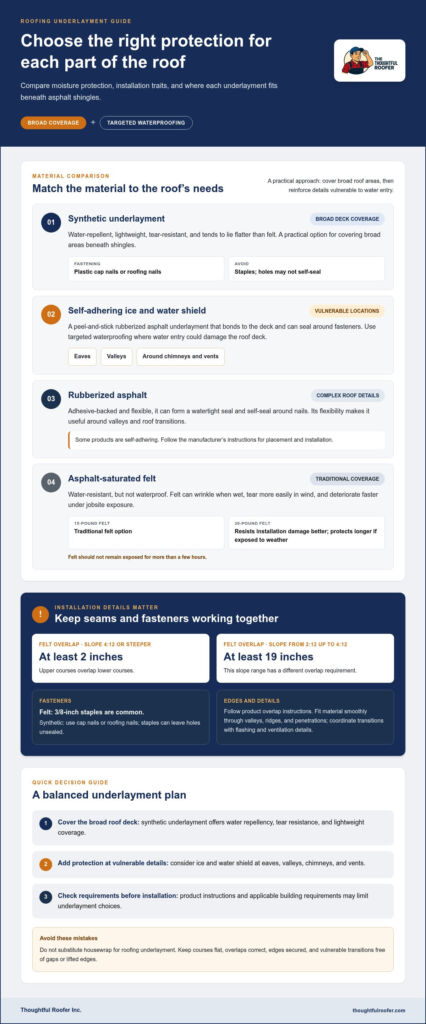
For a shingle roof in Huntsville, choose underlayment based on the roofing material, roof details, and installation conditions. Synthetic underlayment can cover broad areas, while self-adhering ice and water shield adds waterproofing at vulnerable locations.
Asphalt-Saturated Felt Underlayment
Asphalt-saturated felt is a traditional underlayment available in 15-pound and 30-pound versions. It resists water but isn’t waterproof, so it offers less moisture protection than rubberized asphalt. The 30-pound version resists installation damage better than 15-pound felt and protects the roof longer if exposed to weather. Felt can wrinkle when wet, tear more easily in wind, and deteriorate faster under jobsite exposure.
Rubberized Asphalt Underlayment
Rubberized asphalt has an adhesive backing and is applied directly to the roof deck. It can form a watertight seal and self-seal around nails, unlike felt, which is water-resistant rather than waterproof. Its flexibility makes it useful around complex areas such as valleys and roof transitions. Some products are self-adhering, so follow the manufacturer’s instructions for placement and installation.
Self-Adhering Ice and Water Shield
Ice and water shield is a self-adhering rubberized asphalt underlayment, often sold in peel-and-stick form. It bonds to the deck and can seal around fasteners. Consider it for eaves, valleys, and areas around chimneys and vents, where water entry could damage the roof deck. This provides targeted waterproofing without requiring the same material across the entire roof.
Synthetic underlayment is another option for broad coverage. It is water-repellent, tear-resistant, lightweight, and tends to lie flatter than felt. For Huntsville projects, homeowners often rely on professionals like Thoughtful Roofer Inc. to compare product installation requirements, roof layouts, and local weather exposure. Building codes and manufacturer requirements may also limit underlayment choices.
The table compares common options by practical features:
| Underlayment | Moisture protection | Installation and durability | Typical use |
|---|---|---|---|
| Asphalt-saturated felt | Water-resistant, not waterproof | May wrinkle when wet or tear in wind | Traditional coverage beneath shingles |
| Synthetic | Water-repellent | Lightweight and tear-resistant | Broad roof-deck coverage |
| Rubberized asphalt | Waterproofing; may self-seal around nails | Adhesive-backed and flexible | Vulnerable or complex roof areas |
| Peel-and-stick ice and water shield | Watertight seal when properly applied | Self-adhering to the deck | Eaves, valleys, and penetrations |
Choose a combination that provides broad deck coverage while adding protection at vulnerable details. Follow product instructions and applicable local requirements.
Common underlayment selection and installation mistakes
Choosing a suitable material is only part of protecting the roof deck. Incorrect overlaps, fasteners, or edge details can leave paths for water.
Local building codes and manufacturer requirements can limit which underlayment types are approved, so account for both when selecting materials.
Synthetic Underlayment at Roof Edges
Synthetic underlayment is generally fastened with plastic caps or roofing nails. Staples are discouraged because synthetic material does not self-seal around them. At roof edges, follow the product’s installation instructions and maintain the specified overlap. The material’s strength cannot make up for poor fastening. Correct edge placement helps keep wind-driven rain from reaching the roof deck.
Installation in Vulnerable Roof Areas
Valleys, ridges, and roof penetrations need careful detailing because they interrupt continuous runs of underlayment. A wrinkle or misplaced seam in a valley can direct water beneath the material instead of toward the roof edge. Fit the underlayment smoothly, maintain proper overlaps, and coordinate transitions with flashing and ventilation details.
Overlap requirements depend on both material and roof slope. On steep-slope roofs of 4:12 or steeper, upper felt courses should overlap lower courses by at least 2 inches. For felt on slopes from 2:12 up to 4:12, courses should overlap by at least 19 inches. Those figures apply to different slope ranges, so don’t treat them as interchangeable.
Fasteners are another common source of trouble. Staples measuring 3/8 inch are common for felt, while synthetic underlayment generally calls for cap nails or roofing nails. Using staples on synthetic can leave fastener holes unsealed. Match the fastening method to the material, and place fasteners so the sheet lies flat without loose edges.
Housewrap is not a substitute for roofing underlayment. It does not meet roofing underlayment requirements, and using it beneath shingles is a defective installation. Leaving felt exposed too long can also damage it: felt should not remain exposed for more than a few hours because hot weather can dry it out or leach oil.
A practical installation check is to confirm that each course sheds water over the course below, then inspect valleys, ridges, and penetrations for gaps or lifted edges. Correct overlap and fastening work together to create a watertight barrier. For shingle roofs, professional asphalt shingle roofing can address underlayment details alongside the roof system.
Is Ice and Water Shield Underlayment Worth the Extra Cost?
Ice and water shield adds targeted waterproofing beneath shingles, but it is not automatically needed across every roof area. Its value depends on where water could enter and how the rest of the underlayment performs.
Self-adhering ice and water shield is required when applicable building codes or roofing-system manufacturer instructions specify it. Eaves, valleys, and areas around chimneys and vents are common locations for added protection.
The installed price per square foot depends on roof area, slope, access, preparation, material choice, and labor, and is given after a quote request.
Underlayment as a Secondary Water Barrier
Underlayment sits between the roof deck and shingles, providing backup protection if shingles are damaged or compromised. It can help keep water from reaching the deck and interior, but it does not replace sound shingles, flashing, or drainage. A leak near a valley, for example, can test each layer, so proper alignment and sealed transitions matter.
At vulnerable areas, peel-and-stick rubberized asphalt bonds to the deck and can seal around nails. That distinguishes it from felt underlayment, which is water-resistant rather than waterproof. A watertight layer in a valley or around a roof opening can add protection where water concentrates, while another suitable underlayment covers the rest of the deck.
Water Resistance, Tear Strength, and Traction
Compare materials by moisture protection, tear resistance, and handling during installation. Synthetic underlayment is water-repellent, tear-resistant, and generally handles foot traffic better than felt. Surface texture and walking characteristics vary by product, so follow the manufacturer’s instructions for installation and safe handling.
Felt underlayment is available in 15-pound and 30-pound versions. Both are water-resistant, not waterproof; 30-pound felt resists installation damage better than 15-pound felt and protects the roof longer if exposed to weather. Felt can wrinkle when wet and tear more easily in wind, making exposure and installation conditions important.
Rubberized asphalt uses polymers and an adhesive backing to create a waterproof layer. It is flexible around complex details and can self-seal around fasteners. These are material costs, not installed prices per square foot.
For a practical decision, reserve the strongest waterproofing for vulnerable details, then compare other underlayment options by durability, installation exposure, and manufacturer requirements. Added protection is most useful where roof geometry or water flow makes a leak path more likely.
Combining synthetic underlayment with ice and water shield
A practical shingle-roof assembly can pair synthetic underlayment across the roof deck with self-adhering ice and water shield in vulnerable areas. This approach matches broad coverage with stronger waterproofing where roof details concentrate moisture.
Synthetic Underlayment Advantages and Limitations
Synthetic underlayment is made with polypropylene fibers and sometimes rubber polymers. Compared with felt, it is generally lighter, stronger, more tear-resistant, and flatter on the roof deck. It also handles foot traffic during installation better and resists prolonged sun exposure. However, water-repellent synthetic material is not the same as a waterproof, self-adhering shield.
For asphalt shingles, synthetic underlayment can serve as the main layer across broad roof areas. Ice and water shield can add a waterproof layer at eaves, valleys, and around roof penetrations. This avoids treating every part of the roof as equally vulnerable. Roof shape, low-slope sections, and manufacturer instructions help determine where each material belongs.
Synthetic Underlayment Water and Tear Resistance
Synthetic underlayment repels water and resists tearing, helping it stay intact during installation and exposure. It is also up to four times lighter than other underlayment. These strengths do not eliminate the need for careful seams, fastening, and flashing. Water can still enter through an opening or a poorly coordinated transition.
Exposure time varies by product. Synthetic underlayment can remain exposed for up to six months, while some products allow exposure from six months to a year, depending on manufacturer recommendations. High-performance synthetic can also remain exposed for up to six months. Follow the specific product’s instructions when planning the work before shingles go on.
To combine materials, plan the roof in zones. Place self-adhering shield at vulnerable details, then cover the remaining deck with synthetic underlayment, following each product’s specified overlaps and fastening methods. In a valley, for example, the shield provides waterproofing beneath the shingle layers, while synthetic protects the adjacent deck. Keep transitions continuous and coordinated with flashing.
A very low-slope roof may need underlayment with enhanced waterproofing, so broad synthetic coverage alone may not provide enough protection. Ice and water shield can supplement the assembly where appropriate, but the roof’s slope and material instructions determine the right arrangement. No underlayment lasts for decades without the complete roof system working together: shingles shed most water, while underlayment provides backup against moisture intrusion.
For homeowners comparing options, use synthetic for strength and broad coverage, then reserve self-adhering shield for areas needing stronger waterproofing. Follow manufacturer directions for exposure, placement, and compatibility so the layers work as one system.
Underlayment compatibility with roofing materials
Underlayment needs to work with the roofing material above it, not just the roof deck below. Asphalt shingles and metal roofing have different requirements for heat resistance, exposure, and water protection, making compatibility central to a durable roofing system.
For most asphalt shingle roofs, synthetic underlayment is a practical choice that balances weather resistance, strength, and value. Follow the asphalt shingle and underlayment manufacturers’ instructions, since their requirements can determine approved materials, placement, and overlap.
Under asphalt shingles, synthetic underlayment provides a water-repellent backup barrier across the deck. Self-adhering rubberized asphalt can add waterproofing at vulnerable details such as valleys or roof penetrations. The materials serve different roles: broad coverage and targeted sealing. The underlayment must also suit the roof’s slope and the time it may remain exposed before shingles are installed.
Metal roofing calls for a different compatibility check. The underlayment must be rated for the temperatures the roof can reach. High-quality synthetic underlayment or specialized high-temperature self-adhering products are often a better fit beneath metal than a material chosen only for its performance under shingles. Some rubberized asphalt products are designed to resist heat up to 250°F without adhesive degradation, but that capability applies to those products, not every underlayment.
Before selecting a product, match these factors to the roofing material and roof conditions:
- Roof covering: Asphalt shingles and metal roofing have different heat and underlayment demands.
- Temperature rating: For metal, the underlayment must withstand the roof’s potential heat.
- Exposure period: Check how long the material can stay uncovered under its manufacturer’s directions.
- Roof details: Valleys, penetrations, and low-slope sections may need additional waterproofing.
- Installation design: Follow required overlap and fastening instructions so the barrier sheds water correctly.
Compatibility also depends on how the layers meet. An underlayment suited to the field of an asphalt-shingle roof, for example, may not provide the right high-temperature performance beneath metal. At transitions, the underlayment, flashing, and roofing material must work together, with seams positioned to direct water outward rather than beneath the barrier.
Compare the roofing material, exposure, temperature demands, and manufacturer instructions before choosing. That sequence helps prevent a mismatch between the underlayment and the finished roof. For help planning an asphalt shingle roofing system around compatible materials and roof details, discuss your asphalt shingle roof.
Synthetic underlayment is a practical choice for most asphalt shingle roofs. Follow the asphalt shingle manufacturer’s instructions for approved materials and installation.
Thoughtful Roofer Inc.: Asphalt Shingle Roofing
Thoughtful Roofer Inc. provides Asphalt Shingle Roofing for homeowners planning a new roof or addressing concerns with an existing shingle system. If you’re weighing underlayment options, a roof assessment can help identify vulnerable areas, signs of water entry, and whether repairs or replacement suit the roof’s condition.
Turn to Thoughtful Roofer Inc. when planning shingle roofing work, noticing a leak, or assessing storm damage. Contact Thoughtful Roofer Inc. to discuss your roof and next steps.
Plan the Roof as a Complete System
Your next step is to connect the underlayment decision to the roof’s overall condition and design. The question “what is the best underlayment for a shingle roof” is only part of the decision; drainage, roof edges, and transitions all affect how well the layers work together. Considering the whole system helps you choose an approach that supports your home, rather than focusing on one material alone.
Thoughtful Roofer Inc. offers Asphalt Shingle Roofing, Metal Roofing, and Seamless Gutters to address connected roofing and drainage needs. If you’re planning a roof project or want to discuss how its materials fit together, contact Thoughtful Roofer Inc. to talk through the next step. A clear plan can make a complex home decision feel more manageable and help you move forward with confidence.
Frequently Asked Questions
Which option is best for asphalt shingles?
For most asphalt-shingle roofs, synthetic underlayment is a practical starting choice because it balances weather resistance, strength, and value. If you’re asking what is the best underlayment for a shingle roof, consider the full roof layout rather than choosing one product for every location. For example, a roof may use synthetic across broad areas and self-adhering protection at vulnerable details, with product instructions guiding the final assembly.
What types of underlayment are used under asphalt shingles?
The main choices are asphalt-saturated felt, synthetic underlayment, and rubberized asphalt products, including peel-and-stick ice and water shield. Felt comes in different weights, while synthetic is made with polypropylene fibers and sometimes rubber polymers. Rubberized asphalt has an adhesive backing and is often used where added waterproofing is needed. A shingle roof can combine materials, so the underlayment may differ between the main deck and vulnerable details.
Is synthetic or felt underlayment better for a shingle roof?
Synthetic generally offers greater tear resistance and handles foot traffic during installation better than felt, while felt is a familiar, lower-cost material option. Felt can wrinkle when wet and is more vulnerable to tearing during windy installation. The better fit depends on roof shape, installation exposure, and material instructions. For instance, a project exposed to weather during installation may benefit from synthetic’s durability and ability to stay flatter.
What are the pros and cons of synthetic, felt, and rubberized asphalt underlayment?
Synthetic is lightweight, water-repellent, and tear-resistant, but it needs the correct fasteners and is not a self-adhering waterproof layer. Felt is widely available and water-resistant, but can wrinkle when wet and tear more easily. Rubberized asphalt offers adhesive-backed waterproofing and can seal around fasteners, though it is usually used selectively. Compare each material’s role, exposure limits, fastening needs, and compatibility with the roofing system.
How does climate and roof slope affect underlayment choice?
Weather exposure affects how well underlayment withstands installation and uncovered periods, so follow the product’s exposure instructions. Roof slope also changes water-management needs. Very low-slope sections may need enhanced waterproofing. For felt, slopes from 2:12 up to 4:12 call for at least 19 inches of overlap; on slopes of 4:12 or steeper, upper courses overlap lower courses by at least 2 inches. These slope-specific directions aren’t interchangeable.
What are common underlayment installation mistakes and risks?
Common mistakes include using housewrap instead of roofing underlayment, choosing fasteners that do not suit the material, and leaving gaps at seams or roof transitions. These errors can create paths for water to reach the deck. For example, synthetic underlayment generally needs cap nails or roofing nails, not staples. Check that each course overlaps correctly, lies flat, and coordinates with flashing at valleys, ridges, and roof penetrations.
What are the ASTM standards and building code requirements for shingle roof underlayment?
The article reports that, as of 2010, no applicable ASTM standards existed for synthetic underlayment. Local building codes and manufacturer requirements may restrict which underlayment types are approved.