Most homeowners in Huntsville and Madison assume that if their shingles are still on the roof, the storm didn’t do any real damage. You probably feel a sense of relief when you look up after a heavy North Alabama windstorm and don’t see any bare spots. However, wind damage is often a silent killer that works beneath the surface, and knowing how to tell if shingles are damaged by wind is the first step in preventing attic rot. It’s stressful to wonder if a hidden leak is compromising your home or if an insurance adjuster will overlook the signs of a failing roof.
This guide provides the professional clarity you need to identify subtle seal failures and “wind uplift” patterns common in the Tennessee Valley. We will walk through the critical 2026 Alabama building code requirements, such as the 130 MPH wind rating, and explain the 12-month window for filing insurance claims. You’ll learn how to document evidence like an expert, using the same meticulous approach we use in our proprietary inspections. By the end of this article, you will be prepared to act as an advocate for your home’s safety and avoid the high-pressure tactics of “storm chaser” contractors.
Key Takeaways
- Understand how North Alabama wind patterns create “uplift” that compromises your roof’s seal even when shingles appear to be perfectly in place.
- Learn how to tell if shingles are damaged by wind from the safety of the ground by identifying subtle creases and “scuffing” that signal a compromised structure.
- Discover the specific differences between natural thermal wear and actual storm damage to ensure your insurance claim is based on accurate evidence.
- Organize a “Storm Folder” with dates and photos to meet Alabama’s typical one-year insurance filing window and protect your household’s financial security.
- Recognize why professional inspections uncover the hidden damage that often remains invisible to the untrained eye, preventing long-term attic rot and mold.
Understanding the Mechanics of Wind Damage on Asphalt Shingles
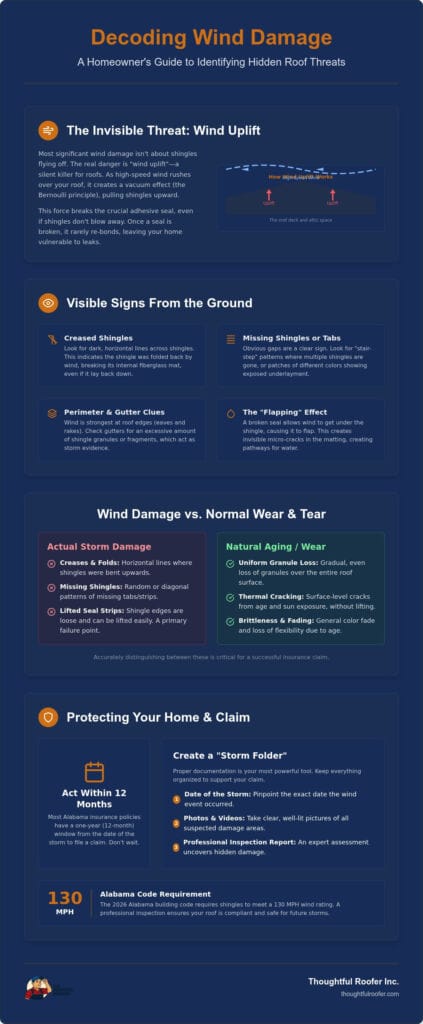
Did you know that most roof damage in North Alabama doesn’t involve shingles flying off into the neighbor’s yard? While a missing shingle is an obvious problem, the most dangerous form of storm damage is the silent compromise of your roof’s structural seal. Wind damage occurs when the attachment or the adhesive bond of your shingles is broken. This often happens because of the Bernoulli principle; as high-speed wind moves over your roof peak, it creates a vacuum effect that pulls upward on the materials. This lift is what causes shingles to loosen, even if they don’t blow away entirely.
Understanding the wind resistance of asphalt shingles is essential because it helps you distinguish between minor cosmetic issues and structural failure. While blow-offs are easy to spot, racking damage involves the stress placed on the fasteners and the matting when wind forces the shingles to shift laterally. If you are wondering how to tell if shingles are damaged by wind, you must look beyond the obvious gaps and focus on the integrity of the seal itself. Unsealed shingles represent the primary stage of failure, acting as a gateway for moisture to enter your attic.
The Role of the Shingle Seal Strip
Every modern asphalt shingle features a factory-applied adhesive strip designed to bond it to the layer below. This bond is the primary defense against the straight-line winds we frequently see in Huntsville and Athens. However, the extreme temperature fluctuations in the Tennessee Valley can make these seals brittle over time. When a seal is broken by a storm, it rarely re-bonds effectively on its own. Seal strip failure is a structural compromise that leaves your home vulnerable to the next round of rain.
Uplift and the ‘Flapping’ Effect
Once a seal is broken, wind can easily get under the edge of the shingle. This creates a flapping motion during a storm. Even if the shingle stays attached to the nail, this repeated movement creates micro-cracks in the internal fiberglass matting. These cracks are invisible from the ground but act as pathways for water to reach your roof deck. Many homeowners don’t realize that shingles that lay back down after a wind event are still permanently damaged. This hidden failure is why knowing how to tell if shingles are damaged by wind requires a deeper look at how the materials interact with the elements.
Visible Signs of Wind Damage: What to Look for from the Ground
Have you ever stood in your driveway after a storm, looking up and wondering if your home is still truly secure? It’s a common feeling for families in Huntsville and Madison after our seasonal wind events. Learning how to tell if shingles are damaged by wind doesn’t require you to balance on a risky ladder; in fact, we recommend staying on the ground for your initial assessment. Using a pair of binoculars, you can safely scan the surface for “creased” shingles. These appear as dark, horizontal lines where the shingle was folded back by the wind and then flopped back down. While the shingle is still there, the internal fiberglass matting is broken, leaving your roof vulnerable to leaks.
You should also pay close attention to the perimeter of your roof. Wind speeds are naturally higher at the eaves and rakes, making these areas the most likely starting point for failure. If you see any black, papery material peeking through, that is your underlayment or “felt paper.” This is a critical emergency. Exposed underlayment means your primary line of defense is gone, and water can move directly into your roof deck and attic. Catching these signs early is the best way to avoid the stress of a major storm damage repair later on.
Missing Shingles and Tab Damage
When wind speeds reach high levels, they often tear away individual tabs or entire strips. Look for “stair-step” patterns where multiple shingles have been stripped away in a diagonal line. If you notice patches that look darker or a different color than the rest of the roof, you’re likely looking at newly exposed asphalt or underlayment. Distinguishing between a single missing tab and a full-strip failure is important; a full strip missing usually indicates that the fasteners were pulled through the material, which is a sign of significant wind uplift.
Gutter Clues and Perimeter Issues
Your gutters often act as a collection point for storm evidence. Check your downspouts for an unusual amount of shingle granules or actual shingle fragments that may have broken off during the “flapping” effect mentioned earlier. If your seamless gutters appear loose or are pulling away from the house, it may signal that wind got underneath the roof’s edge and lifted the drip edge or flashing along with it. These perimeter components are your roof’s armor, and any visible gap or lifting suggests the wind has compromised the seal of the entire system.
Wind Damage vs. Normal Wear: The Thoughtful Differentiation
How do you know if that mark on your roof is a battle scar from a storm or just a sign of a long Alabama summer? Many homeowners in Madison and Athens find themselves staring at their roof, trying to decipher the patterns. While some wear and tear is natural as your roof ages, storm damage is a sudden event that requires immediate attention. One of the most effective ways to tell if shingles are damaged by wind is the “Lift Test.” During our proprietary inspections, we gently try to lift the shingle tab. If it comes up easily, the seal has failed. If it resists, the integrity is still there. This is a far more reliable indicator than just looking for missing pieces.
You may also notice shingles that are “curling” at the edges. While this looks like the wind might have pulled them up, it is often a sign of poor attic ventilation rather than storm damage. In the Tennessee Valley, heat can build up in an attic and bake the shingles from the inside out, causing them to distort. Wind damage is typically localized to specific slopes or areas where the wind hit hardest, whereas ventilation issues often affect the entire roof surface. Distinguishing between these two is vital for your peace of mind and your insurance claim accuracy.
Wind Creases vs. Shingle Blistering
A wind crease is a distinct horizontal line of granule loss near the top of the shingle tab, caused by the shingle being repeatedly folded back by high gusts. In contrast, blistering appears as small, circular pockmarks. Blistering happens when moisture gets trapped in the shingle during manufacturing and “pops” during our intense summer heat. It is a vital distinction to make because insurance companies almost always cover wind creases as legitimate storm damage, but they rarely cover blistering, which they categorize as a manufacturing defect or a maintenance issue.
Identifying Mechanical Damage
During high winds, nearby trees can become a major threat to your home’s safety. Tree limb “scouring” occurs when branches scrape across the roof, stripping away the protective granules in a broad, messy pattern. You might also see “chaffing,” where loose shingles have rubbed against one another during the flapping effect. Mechanical damage caused by storm-driven debris or falling limbs is a valid insurance claim because it represents a sudden loss of the roof’s protective layer directly caused by the weather event. Identifying these signs early prevents the damage from evolving into a costly leak that could threaten your family’s comfort.
How to Document Wind Damage for an Insurance Claim
Does the thought of filing an insurance claim feel more overwhelming than the storm itself? Managing the administrative side of home maintenance is often the most stressful part of the recovery process. While you now know how to tell if shingles are damaged by wind, providing clear evidence to an adjuster is a different challenge. Our first and most important rule is safety: never walk on a steep or wet roof to take photos. You can capture most of what you need from the ground or a safe distance using your phone’s zoom or a pair of binoculars.
Start by creating a “Storm Folder” on your phone or computer to organize your evidence. As you take close-up photos of debris or lifted edges, place a reference object like a quarter next to the damage. This provides the adjuster with a clear sense of scale. A “ground-up” strategy works best; start with wide context shots of your entire home and move toward specific areas of concern. This methodical approach demonstrates that you are an organized and informed homeowner, which helps prevent unnecessary claim denials during the review process.
The Homeowner’s Photo Checklist
Capturing the right images makes the advocacy process much smoother. We recommend following this simple checklist to ensure nothing is missed:
- Wide yard shots: Take photos of each roof slope from the street or backyard to show the overall context.
- Debris documentation: Photograph any shingle tabs, granules, or pieces of flashing you find in your lawn or landscaping.
- Interior evidence: Check your attic and ceilings for new water spots or dampness that appeared immediately after the wind event.
Timing and Local Weather Records
Speed is your ally when dealing with weather-related damage. In Alabama, most policies require you to file a “Notice of Loss” within one year, but reporting it immediately protects your household from further leaks. You can find official wind speed records for Huntsville or Madison through the National Weather Service to correlate the damage with a specific date. According to Alabama Department of Insurance guidelines, insurers must acknowledge your claim within 15 days of filing. For more detailed support, review our Storm Damage Roof Repair in Huntsville, AL: The Homeowner’s Recovery Guide. If you feel unsure about the evidence you’ve gathered, a professional storm damage repair consultation can provide the expert documentation needed to secure your home’s future.
Why a Professional Inspection is Essential for Hidden Wind Damage
Have you ever looked at your roof after a heavy storm and felt a lingering sense of doubt, even if everything seemed to be in place? While knowing how to tell if shingles are damaged by wind from the ground is a great start, professional data suggests that roughly 60% of wind-related issues are invisible to the untrained eye. This is primarily because wind damage often involves “latent failure,” where the shingle appears perfectly intact but has actually lost its structural adhesive bond. In the Tennessee Valley, our high humidity levels mean that even a tiny breach in your roof’s seal can lead to rapid wood decay. If these micro-failures are ignored, they typically result in attic rot or mold within six months, turning a manageable storm event into an expensive household crisis that threatens the safety of your structure.
The Thoughtful Roofer Inc. Proprietary Method
Our veteran-owned team approaches every roof with a commitment to absolute transparency and neighborly trust. We don’t just walk the surface; we utilize the Thoughtful Roofer Inc. proprietary inspection method to look deeper than a standard contractor might. This involves a meticulous check of your attic space to identify “seepage” points where moisture might be bypassing the shingles without staining your drywall or ceiling yet. We focus on the longevity of your materials, recognizing that North Alabama heat can further degrade a compromised seal. We pride ourselves on our integrity. If our assessment shows your roof is still secure and doesn’t require a full replacement, we will provide that honest news rather than pushing for unnecessary work. We view our role as a protective mentor for the Huntsville and Athens communities, prioritizing your peace of mind over a sales quota.
Your Advocate in the Claims Process
The complexity of the insurance world is one of the biggest hurdles for Madison homeowners trying to recover after a storm. Adjusters are often overwhelmed after a major North Alabama storm and may miss the subtle signs of uplift at the roof’s perimeter or the specific fastening failures common in older homes. We act as your full-service partner and administrative advocate by attending the adjuster’s meeting to present our technical findings clearly. By providing the specific documentation and photo evidence required for claim approval, we help prevent the frustration of a “no damage found” denial. For more detail on this journey, read our Roof Repair in Huntsville, AL: The Thoughtful Homeowner’s Guide. We are here to stabilize the situation and guide you toward a safe, long-lasting resolution that protects your family for years to come.
Securing Your Home After North Alabama Storms
Protecting your home against the unpredictable weather of the Tennessee Valley is a continuous journey. By understanding the mechanics of wind uplift and knowing how to tell if shingles are damaged by wind, you’ve taken the first step toward ensuring your household’s safety. Remember that while missing shingles are obvious, the invisible compromise of a broken adhesive seal is often where the most significant long-term damage begins. Identifying these subtle signs early prevents the stress of attic rot and costly structural repairs down the road.
As a veteran-owned company specialized in North Alabama storm restoration, we’re here to act as your stabilizing guide through the recovery process. Our proprietary 21-point inspection method is designed to uncover the hidden vulnerabilities that adjusters often miss, providing you with the technical clarity and administrative advocacy you deserve. You don’t have to navigate the aftermath of a storm alone or worry about high-pressure sales tactics.
Schedule Your Thoughtful Storm Damage Inspection Today and gain the peace of mind that comes with a truly secure roof. Your home is your sanctuary, and we’re committed to keeping it that way.
Frequently Asked Questions
Can wind damage shingles without blowing them off?
Wind can absolutely damage shingles without removing them from the roof deck. This often occurs when gusts break the adhesive seal strip, causing the shingle to flap and develop invisible micro-cracks in the fiberglass matting. If you are learning how to tell if shingles are damaged by wind, remember that a shingle that has lifted and laid back down is still structurally compromised. These hidden failures are what lead to attic seepage during the next heavy rainstorm.
How much wind does it take to damage a standard asphalt shingle roof?
Damage can occur at different thresholds depending on your roof’s material and age. Standard 3-tab shingles are often rated for only 60 to 70 MPH winds, making them vulnerable to typical North Alabama spring storms. In contrast, the 2026 Alabama building code requires new architectural shingles to resist speeds of 130 MPH or more. Even high-rated shingles can suffer damage if the installation didn’t include the proper six-nail fastening pattern required for our region.
Is wind damage covered by standard homeowners insurance in Alabama?
Yes, wind damage is typically a covered peril under standard homeowners insurance policies in Alabama. Because our region faces extremes like tornadoes and straight-line winds, these events are recognized as sudden and accidental losses. You’ll generally be responsible for your deductible, but the remaining restoration costs for your asphalt shingle roofing should be covered. We recommend reviewing whether your policy provides Replacement Cost Value or Actual Cash Value to understand your coverage.
What happens if I ignore minor wind damage on my shingles?
Ignoring minor damage often leads to much more expensive structural issues within six to twelve months. When a shingle seal is broken, water can be driven upward under the material by the wind. This moisture eventually rots the wooden roof deck and creates a breeding ground for mold in your attic insulation. What starts as a simple repair can quickly escalate into a full system failure that threatens your family’s health and safety over time.
How long do I have to file an insurance claim for wind damage?
Most insurance policies in Alabama require you to file a claim within one year of the storm event. While state law doesn’t set a rigid deadline, waiting too long makes it difficult to prove the damage was caused by a specific weather occurrence rather than normal wear. It’s best to report the issue as soon as you discover signs of failure. Prompt action ensures you stay within the 30-day window insurers typically have to accept or deny a claim.
Can I repair just the wind-damaged shingles, or do I need a full replacement?
Whether you need a partial repair or a full replacement depends on the extent of the damage and the age of your roof. If only a few shingles are affected and the rest of the roof is pliable, a localized repair is often possible. However, if the shingles are old and brittle, attempting to replace a few can damage the surrounding ones. We use a proprietary inspection to determine if the roof is repairable according to current industry standards.
Why does my roof look fine from the ground but leak after a wind storm?
Roofs often appear perfect from the driveway while harboring significant structural issues. High winds create a vacuum effect that pulls shingles upward, snapping the adhesive bond without tearing the material away. This allows water to enter through “capillary action” or wind-driven rain. Understanding how to tell if shingles are damaged by wind involves looking for these invisible seal failures. A professional inspection often reveals that the protective barrier is no longer watertight despite its outward appearance.
What is the difference between a wind crease and a hail hit?
The primary difference lies in the shape and cause of the granule loss. A wind crease is a sharp, horizontal line near the top of the shingle tab where it folded backward during a gust. Hail damage, on the other hand, usually appears as circular “bruises” or indentations spread randomly across the roof surface. While both compromise your home’s safety, insurance adjusters look for these specific patterns to categorize the type of storm event that occurred and determine your claim eligibility.