What if the most important part of a roofing project is settled before anyone climbs onto the roof? Knowing how to read a roofing contract can help you spot vague work descriptions, unclear material details, and payment terms that leave too much open to interpretation. It’s reasonable to want answers before you sign, especially when your home needs repairs after a storm.
A clear contract is a written map of the work, costs, changes, and responsibilities. This guide explains how to review the scope, materials, payment schedule, change orders, exclusions, warranties, and insurance language. If storm damage is involved, Thoughtful Roofer Inc. assists with damage documentation and insurance-claim coordination. By the end, you’ll know what to look for and how to get important details resolved in writing before signing.
Key Takeaways
- Learn how to read a roofing contract by treating it as a written map of the work, costs, changes, and responsibilities.
- Compare the listed roofing work and materials with your understanding of the project, and look for exclusions that could affect the finished job.
- Understand the difference between fixed terms, allowances, and written change orders so you can follow payment and extra-work language.
- Review schedule and warranty wording carefully, including the distinction between workmanship terms and manufacturer material coverage.
- Use a pre-signing checklist to catch unclear details, resolve them in writing, and keep a copy of the final signed agreement.
How to Read a Roofing Contract: Start with the Work It Promises
Comparing a proposal, formal agreement, and notes from a conversation can feel like a lot to sort through. Take it clause by clause. Start by identifying what each document says the roofer will do, then note any terms that differ or leave room for interpretation. This is a practical way to learn how to read a roofing contract without feeling rushed.
A roofing contract is a written agreement that describes the roofing work, materials, payment terms, and responsibilities of the homeowner and contractor.
The signed agreement and its attachments give you a record to refer to. A conversation can help explain the plan, but an important promise may be hard to follow later if it isn’t written into the agreement or a signed attachment. For background on the trade and the roles involved, the Wikipedia article on Roofers offers a general overview. Your own paperwork should describe the commitments for your project.
Which documents belong with the agreement?
Gather the proposal, written contract, material specifications, and any signed change documents. The main agreement may be brief, while an attachment identifies the selected roofing material or adds detail about the work. Read these pages together rather than treating a proposal or specification sheet as separate from the agreement.
- Proposal: Compare its description of the planned work with the formal contract.
- Material specifications: Look for details that identify the materials called for in the project.
- Signed change documents: Keep a record of any agreed revisions to the original plan.
Before signing, confirm that each referenced attachment is present and matches the version discussed. Keep a complete, dated copy of every signed document, including later changes. A missing page or undated revision can make it harder to identify the agreed plan.
Who is responsible for each part of the project?
Check that the agreement names the homeowner and roofing company, identifies the property address, and provides clear signature fields. The company responsible for the work should be identified consistently throughout the paperwork. If names or addresses differ between the proposal and contract, have the documents corrected before signing.
Look for blank fields that could affect your understanding of the agreement, such as an unfinished project description or missing attachment reference. Don’t rely on an informal promise to fill in a gap. Ask for important clarifications to be added in writing and included with the documents you sign. That way, everyone is working from the same plan.
Check the Roofing Scope, Materials, and Exclusions Line by Line
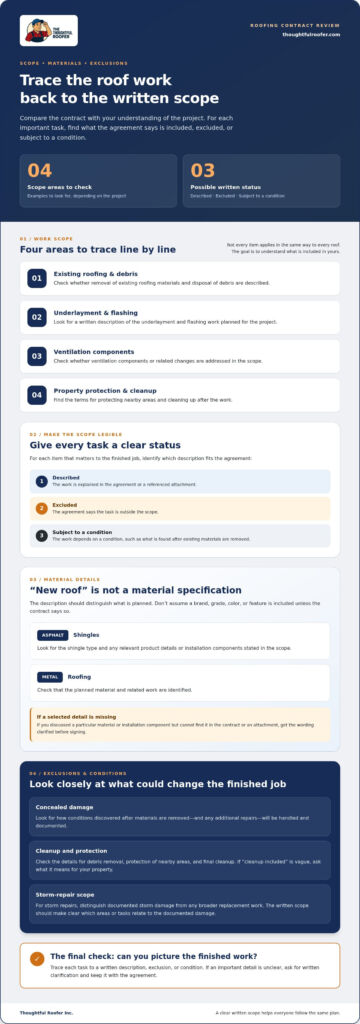
A contract can name the general project without explaining every task involved. Compare its written scope with your understanding of the work and look for gaps. To practice how to read a roofing contract, picture the finished job, then trace each step back to a written description. If a task matters to the result, make sure the paperwork addresses it or states clearly that it’s outside the scope.
Depending on the project, look for clear descriptions of:
- Removal of existing roofing materials and disposal of debris
- Underlayment and flashing work
- Ventilation components or related changes
- Protection of the property and cleanup after the work
These items don’t apply in the same way to every roof. The goal isn’t to expect identical work in every contract, but to understand what is included in yours. For each item, note whether the agreement describes the work, excludes it, or makes it subject to a condition.
How specific should the shingle and installation description be?
The material description should give you enough detail to distinguish what’s planned, rather than simply saying “new roof.” For asphalt shingles, look for the shingle type and any relevant product details or installation components stated in the scope. A metal roofing description should identify the planned material and related work. Don’t assume a brand, grade, color, or feature is included unless the contract says so. If the agreement refers to a specification, make sure you have it.
Compare the description with what you discussed. If you selected a particular material or installation component but can’t find it in the contract or an attachment, get the wording clarified before signing. Specific details help everyone follow the same plan.
What do exclusions and cleanup terms tell you?
Read exclusions as carefully as the included work. They may list tasks that aren’t part of the agreement or explain how the roofer will handle conditions that aren’t visible until existing materials are removed. Look for wording about concealed damage and additional repairs, including how any changes will be documented. An unclear exclusion can leave you unsure what to expect if the work uncovers a problem.
Check the terms for debris removal, protection of nearby areas, and final cleanup. “Cleanup included” may sound reassuring, but details define what that means for your property. If the agreement is vague about something that matters to you, ask for written clarification rather than relying on an assumption.
For storm repairs in North Alabama, distinguish documented storm damage from any broader replacement work in the written scope. The contract should make clear which areas or tasks relate to the documented damage and which, if any, go beyond it. Thoughtful Roofer assists with storm-damage documentation and insurance-claim coordination, helping homeowners keep project details organized. A roofing project review can help clarify questions about the written scope.
Understand Roofing Contract Payments, Changes, and Insurance Language
Payment terms are easier to assess as a sequence than as a single total. Start with the contract amount, then identify any deposit, progress payments, and final payment. Each amount or percentage should be understandable in relation to the written terms, and each progress payment should have a clear trigger. For example, a payment tied to a project milestone should say what that milestone is. Check what must happen before final payment is due.
This is a key part of how to read a roofing contract: distinguish the agreed price and scope from a placeholder or a later change. These terms serve different purposes.
| Term | What it means to check |
|---|---|
| Fixed contract term | A stated part of the agreed work or payment terms. Check what scope it covers and when payment is due. |
| Allowance | A set amount or placeholder for an item not fully selected or determined in the agreement. Find out what it covers and how adjustments are handled. |
| Written change order | A documented revision to the original agreement. It should describe added or changed work, any price effect, and how approval is recorded. |
How should payment milestones and additional work be documented?
Match each deposit, progress payment, and final payment to a defined contract term or project milestone. If additional work is needed, look for a written process explaining how the change will be described, priced, and approved before it proceeds. A conversation, estimate, or allowance isn’t automatically the same as an approved change. Keep the revised document with the rest of the agreement.
What should storm-related insurance language make clear?
A roofing contract describes the work the company agrees to perform. It doesn’t determine what an insurer will cover; coverage decisions depend on the policy and insurer. Read any claim-related wording to understand who is responsible for preparing or sharing documentation, how proposed supplements are handled, and what tasks remain yours. Don’t assume the agreement guarantees insurer approval or payment, or changes your policy.
For a storm-damage project, keep the written roof scope distinct from claim discussions. Thoughtful Roofer assists with storm-damage documentation and insurance-claim coordination, while the insurer makes its own coverage decisions. The guide to storm damage roof repair in Huntsville can also help you follow the recovery process and keep project paperwork organized.
Review Roofing Timelines, Warranties, and Potential Red Flags
Schedule and warranty clauses help set expectations, but broad promises can be hard to interpret. When learning how to read a roofing contract, look for wording that explains what happens if conditions change, who provides each warranty, and where its full terms can be found. A vague clause isn’t automatically proof of a problem, but it’s a reason to seek a clearer explanation before signing.
What timeline language should homeowners look for?
Check whether the agreement gives a specific start date or a start window and describes the expected duration of the work. Then look for conditions that could shift the schedule, such as weather, material delays, or limited access to the property. The terms should explain how schedule changes will be communicated, rather than leaving you to guess what an open-ended delay means.
Completion language matters, too. Look for a clear description of what counts as finished, such as completion of the listed roofing work and any stated cleanup. If the contract uses phrases like “weather permitting” or “as soon as possible,” consider what they mean for your project and request more precise wording if needed. When circumstances change, ask for a written update that records the revised expectation.
How can you read warranty language without assuming too much?
Separate a workmanship warranty from a manufacturer’s material warranty. The first concerns the contractor’s work under the terms stated in its document; the second comes from the manufacturer and is governed by its own terms. Neither label alone tells you what is covered. Find out who provides each warranty and where its full written conditions are documented.
Review the stated duration, coverage, exclusions, and any maintenance or registration conditions. A broad phrase such as “lifetime coverage” doesn’t explain what qualifies, what is excluded, or whether coverage changes over time. Read the actual warranty documents instead of relying on a summary or verbal description. A separate roofing warranty guide can help you understand the terms in more detail.
Pause to clarify language that seems inconsistent, incomplete, or unusually absolute. Examples include a promised start date with no explanation of delays, a warranty claim that isn’t supported by written terms, or undefined completion conditions. These are reasons to request documentation or clarification, not automatic evidence of wrongdoing. Ask for important explanations in writing. For Alabama-specific contract rules or deadlines, rely on current authoritative information rather than treating a general statement as legal guidance.
Thoughtful Roofer serves homeowners in Huntsville and nearby communities, including Madison, Owens Cross Roads, Gurley, and Athens. Discuss your roofing project with Thoughtful Roofer if you have questions about the work or its documentation.
Use This Pre-Signing Checklist Before You Approve Roofing Work
You don’t have to resolve every roofing-contract question from memory. Use this checklist to review the agreement in a steady order, compare it with your understanding, and identify anything that needs clarification. Knowing how to read a roofing contract means checking details before approval, not guessing what an unclear clause might mean.
- Confirm the parties and property. Check that the homeowner’s name, roofing company, and project address are accurate and consistent throughout the documents.
- Match the scope to the planned work. Make sure the written description reflects the work you expect, including relevant removal, installation, and cleanup details.
- Review the materials. Check that the material type and specifications match the selections documented for your project.
- Trace the payment terms. Identify the contract total, deposit, any progress-payment triggers, and the conditions for final payment.
- Check the process for changes. Look for a written method to describe added or revised work, show any price effect, and record approval.
- Understand the schedule. Review the start window, estimated duration, completion terms, and how weather or other delays will be communicated.
- Check attachments and signatures. Confirm referenced documents are included, required fields are complete, and the final agreement is signed and dated by the appropriate parties.
What to do when a clause is unclear
Mark the exact wording and request a plain-language explanation in writing. If the agreement is revised, compare the new language with the final version before signing, and keep the updated documents together. Don’t rely on a conversation to settle a term that affects your responsibilities or the agreed work. If you need a legal interpretation or are facing a dispute, consult a qualified attorney.
How local roofing support can make the next step easier
Thoughtful Roofer serves Huntsville, Madison, Owens Cross Roads, Gurley, and Athens with residential roofing, repairs, and storm-damage restoration. For storm-related work, the company also assists with insurance-claim documentation and coordination. That support can help keep project information organized, but coverage decisions remain with the insurer and depend on the policy. The Huntsville roofing contractor guide offers additional context for homeowners reviewing their next steps.
Once you’ve worked through the checklist, keep a complete copy of the final signed agreement and its attachments. For residential roofing work in Huntsville and nearby communities, use the checklist to bring clear, specific questions to your project discussion.
Move Forward With Confidence in Your Roofing Agreement
A roofing contract doesn’t need to feel like a test. Give yourself room to pause, mark questions, and get unclear language explained before you decide. Knowing how to read a roofing contract gives you a steadier starting point, but you don’t have to resolve every concern alone. For legal interpretation or a dispute, an attorney can provide independent advice.
For a roofing project in Huntsville, Madison, Owens Cross Roads, Gurley, or Athens, a clear conversation can help turn uncertainty into a practical next step. Thoughtful Roofer is a veteran-owned and operated local business, and its team can discuss the work you’re considering and the project details that matter to your home. For storm-related work, the company also assists with insurance-claim documentation, while coverage decisions remain with your insurer and policy.
When you’re ready to discuss residential roofing plans, talk with Thoughtful Roofer about your residential roofing project. Bring your questions and the agreement details you’d like to review.
Frequently Asked Questions
What should be included in a roofing contract?
A roofing contract should identify the parties and property, describe the agreed work and materials, and explain payment, changes, schedule, and warranty documents. Check that its attachments are named or included so you can tell which specifications apply. For example, if the agreement refers to a material selection sheet, make sure you have it and that it matches the roofing system you chose. Keep the complete signed set together.
Should I sign a roofing contract before an insurance claim is approved?
Don’t assume a roofing contract depends on insurance approval unless its written terms clearly say so. Before signing, understand what work you’re authorizing, what payment responsibilities the agreement places on you, and what happens if the insurer approves only part of a claim or declines it. Your policy and insurer determine coverage, not the roofing contract. For a storm-damaged home in Huntsville or nearby communities, keep claim discussions and project commitments clearly documented.
Can a roofing contractor change the contract after I sign it?
A change to the agreed scope or terms should be presented clearly and documented for the parties’ review and approval. If you receive a revised contract or change order, compare it with the signed version. Check what changed, why, and whether the price or schedule is affected. Don’t treat a new estimate or conversation as an approved revision. If you’re unsure what a change means for your obligations, seek independent legal advice.
What does an allowance mean in a roofing contract?
An allowance is a placeholder for an item or cost that hasn’t been fully selected or determined when the agreement is prepared. Check what it covers, how the final selection will be made, and how any difference from the allowance will be handled. For instance, if an item is still undecided, the contract should make clear how that choice affects the project total. Don’t mistake an allowance for a fully settled price.
What happens if hidden roof damage is found during replacement?
If concealed damage is uncovered, the condition may need to be assessed before the next steps are agreed. Ask for a clear description of the newly discovered issue, any proposed repair, and how the added work could affect the price or schedule. Request this information in a written change document before approving the additional scope. For storm-related damage, keep photos or other project documentation with your records and share relevant claim materials with your insurer.
Is a verbal roofing agreement enough?
A verbal discussion can help explain a project, but it’s a weak substitute for a complete written record of what both sides understand. Details such as which areas will be repaired, what material is selected, or how an added task will be handled can be remembered differently later. Ask for project commitments and revisions to appear in the written agreement or signed documents. If you’re uncertain about the legal effect of a verbal agreement, consult an attorney.
What should I do if I do not understand a roofing contract clause?
Mark the clause and ask the roofing company to explain it in plain language, preferably in writing. Then compare the explanation with the agreement to see whether the wording needs clarification or revision. Don’t sign based on a guess about what a clause means. Homeowners in Huntsville, Madison, Owens Cross Roads, Gurley, and Athens can take time to review their paperwork calmly. For legal interpretation, a potential dispute, or advice about your rights, speak with a qualified attorney.