Some roofers offer payment plans through financing, with promotional repayment terms commonly running 6-18 months. Finding a roofer who offers payment plans in Huntsville, Madison, Owens Cross Roads, Gurley, or Athens, Alabama, means comparing the repayment period, interest, and monthly amount, not just looking for a lower payment today. The right option depends on the project and the terms you qualify for.
A damaged or aging roof can put pressure on a household budget, especially after severe local weather. It’s reasonable to want a clear picture of the cost before choosing between financing, an insurance claim, or paying out of pocket.
This guide explains how roof financing works, what affects monthly payments, and how to compare payment options. It also covers financing versus insurance and cash, so you can weigh the trade-offs and plan a practical next step to protect your home.
Key Takeaways
- Compare the full repayment terms, not only the advertised monthly payment, before choosing roof financing.
- Understand whether a promotion defers payments or interest, since those arrangements can affect what you owe later.
- Use Wisconsin city estimates as a starting point, then account for roof size, materials, and project details when planning your budget.
- Weigh financing against insurance and paying out of pocket based on the type of roof work and your available funds.
- Put the payment schedule and loan terms in writing so you can see when payments are due and how they apply.
Comparing financing with insurance and paying out of pocket
For roof work, compare three routes: an insurance claim, financing, and paying cash. The right choice depends on why the roof needs work, the funds available to you, and the full repayment terms.
Storm damage and insurance: Document the damage with photos and an inspection report, then review your policy’s coverage and deductible. Insurance may help with covered storm damage, but it does not automatically cover an aging roof or routine improvements. Financing may help cover an eligible project cost or insurance deductible, while paying cash avoids loan interest if doing so won’t strain your household budget.
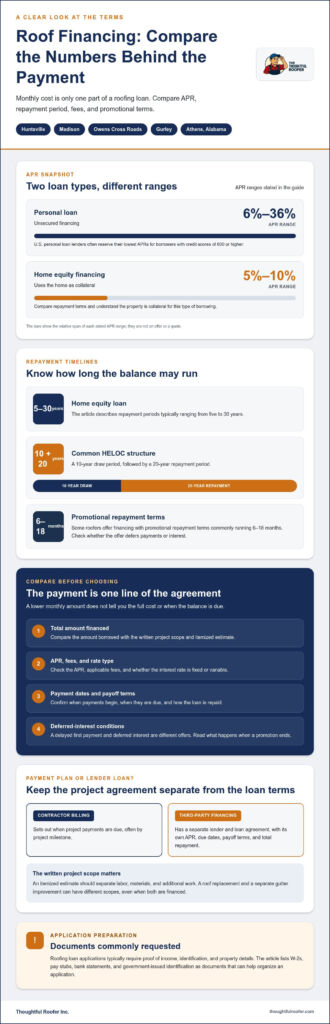
Credit and loan terms: There isn’t one credit score required for every roofing loan. Lenders may weigh credit score, household income, and debt-to-income ratio; U.S. personal loan lenders often reserve their lowest APRs for borrowers with credit scores of 690 or higher. Compare the APR, repayment period, fees, and any deferred-interest conditions, rather than choosing by monthly payment alone.
Checking a contractor: Before signing or financing, request the contractor’s license details and insurance certificate. Match the business name and license information with the relevant Wisconsin licensing authority, and verify coverage with the insurer. Read reviews across multiple platforms; look for consistent descriptions of communication, workmanship, and how the contractor handled concerns.
Contractor Billing and Third-Party Financing
A contractor’s billing schedule sets out when payments are due for project milestones, while third-party financing involves a separate lender and loan agreement. Compare the signed contract’s scope and payment schedule with the lender’s APR, due dates, payoff terms, and total repayment. For example, a roof replacement and a separate gutter improvement may have different scopes, even if you plan to finance both.
Roof Funding Programs
Government or utility programs may help with eligible home improvements, but their purpose and qualification rules differ. The U.S. Department of Housing and Urban Development says an FHA Title 1 loan applicant must have occupied the home for at least 90 days. HUD also says an FHA 203(k) loan can be used for a one- to four-unit dwelling that is at least a year old. Compare eligibility and loan terms before relying on a program to fund replacement work.
Other repairs: A lender may treat gutters, siding, or chimney work differently from a roof replacement, depending on which projects qualify. List each improvement separately in the estimate and financing application. This helps distinguish insured storm damage from elective work and clarifies which costs you’ll cover through insurance, financing, or cash.
What is roof financing?
Roof financing lets homeowners spread the cost of repairs or replacement over time through a loan or payment arrangement. The amount borrowed, interest rate, and repayment period affect the monthly payment.
First, determine whether the roof needs a targeted repair or full replacement. Note active leaks, missing or damaged shingles, and recurring water entry, then use an inspection and written estimate to define the work. A localized leak repair and a full replacement have different scopes and financing needs. Insurance may apply to covered damage, while routine aging or elective improvements call for a separate budget decision.
Estimates and Payment Plan Selection
Request an itemized estimate that separates labor, materials, and additional work. Compare the total amount financed, APR, payment dates, and repayment period with the written project scope. The signed agreement should describe the work and payment schedule. When finding a roofer who offers payment plans, compare these written terms rather than choosing based only on the lowest monthly payment.
How do roofing payment plans compare with personal loans and home equity loans? Personal loans are unsecured and have APRs ranging from 6% to 36%, while home equity financing has an APR range of 5%-10%. Home equity loans use the home as collateral, so compare the repayment terms and understand that borrowing involves the property.
Roof Payment Plan Types
Options include personal loans, home equity loans, HELOCs, and contractor-arranged financing. Home equity loans typically have repayment periods of five to 30 years. A common HELOC structure has a 10-year draw period, followed by a 20-year repayment period.
Review the agreement before signing. Check whether the interest rate is fixed or variable, when payments begin, and whether a promotional offer includes deferred interest. Roofing loan applications typically require proof of income, identification, and property details. Preparing W-2s, pay stubs, bank statements, and government-issued identification can help organize an application.
Costs and Monthly Payments by Wisconsin City
Roofing costs and payments vary by project and location. Regional figures can be a planning reference, but they are not an estimate for a specific property.
Actual estimates depend on roof dimensions, slope, accessibility, materials, and the work required. For homeowners finding a roofer who offers payment plans, compare the project estimate with the lender’s APR, repayment term, and total scheduled payments. Ask for a roof assessment that clearly distinguishes repair from replacement, then use the defined scope to evaluate financing options. A clear roof repair assessment can help establish the work involved before considering a payment plan.
Do roofers offer payment plans?
Roofers may offer financing through a lender or a contractor-arranged billing schedule. Compare the written terms carefully: a delayed first payment and deferred interest are different offers.
What are typical interest rates and fees for roof financing? U.S. personal loan APRs for roof financing range from 6% to 36%, while fixed-rate roofing loans typically start around 11.99%. Promotional offers can advertise a 0% introductory APR, but fees and repayment terms depend on the agreement.
How can you find reputable roofers that offer payment plans near you? Compare local contractors’ written scopes, licensing and insurance details, customer reviews, and payment terms before committing. A signed contract should show the project schedule and payment due dates, while the financing agreement identifies the lender, APR, and repayment obligations.
Deferred Payments and Deferred Interest
Deferred payments delay when a homeowner must begin paying, while deferred interest postpones interest charges under specific promotion terms. Some zero-down plans defer the first monthly payment for 30 to 90 days. That delay doesn’t by itself mean the loan is interest-free. Read the due dates and APR alongside the promotional language to understand what happens after the delay.
Deferred-interest financing carries a separate risk: if you don’t pay the full balance by the end of the promotional period, deferred interest may be charged back to the original purchase date. Build a repayment plan around the deadline instead of assuming smaller early payments will clear the balance in time.
Zero-Interest and Same-as-Cash Offers
Promotional roofing financing can offer zero-interest or zero-payment periods lasting 90 to 365 days. Other plans give borrowers 6-18 months to repay under promotional terms. These offers can make a roof project easier to fit into a household budget, but the promotional period and the payment schedule must be considered together.
A same-as-cash loan has an important distinction: interest starts accruing when funds are disbursed. You may avoid paying interest by clearing the balance within the stated period, but carrying a balance beyond that period can change the total cost. Record the payoff deadline and set a monthly target that clears the amount on time.
Rates, Fees, and Promotional Offers
Rates differ by loan type and borrower qualifications. Personal loan APRs for roof financing range from 6% to 36%, and fixed-rate roofing loans typically start around 11.99%. A 0% introductory APR applies only during its specified period, so compare the rate afterward and any fees listed in the contract.
Before choosing, compare the total repayment amount, required monthly payment, and any payoff penalties. Roofing agreements can state the interest, payment due dates, and early-payoff conditions. For example, when weighing a promotional offer against a longer fixed-rate loan, compare the payoff deadline and total scheduled payments, not just the first bill. Put the dates and obligations in writing.
Down payments and monthly payments
A down payment reduces the amount financed, while monthly payments spread the remaining balance over a repayment period. Compare both with the signed project scope and your household budget before installation begins.
Initial Down Payment
Down-payment requirements depend on the financing option, lender, and loan terms. A zero-down offer may preserve cash at the start but leave a larger balance to repay. A larger initial payment can reduce the amount borrowed, though it also uses funds that may be needed for other household expenses.
Before paying, match the amount due to the signed contract and written payment schedule. Homeowners should not pay 100% upfront in cash for a roofing project. Tie each payment to a defined project milestone, and keep the contract, receipts, and financing agreement together. This creates a clear record of what you paid and what work remains.
Ongoing Monthly Payments
The monthly payment depends on the balance financed, interest rate, and repayment period. Request an amortization schedule to see how each payment is applied to principal and interest. Compare the scheduled payment with your regular budget, including other debts and household costs, rather than relying on an introductory payment alone.
Some lenders consider credit score, household income, and debt-to-income ratio when reviewing an application. U.S. personal loan lenders often reserve their lowest APRs for borrowers with credit scores of 690 or higher. Prepare income records and property details before applying, and avoid submitting multiple applications at once because hard inquiries can affect credit scores.
Installation timing and payment timing are related but separate. The signed project contract should describe the work and payment dates, while the loan agreement sets out repayment obligations. Review both documents together so the first bill, any promotional period, and project milestones fit your cash-flow plan.
Use this checklist before accepting financing:
- Compare the amount due at signing with the amount financed.
- Review the interest rate, repayment period, and total scheduled payments.
- Check the amortization schedule for principal and interest allocation.
- Match every contractor payment to the written, signed project schedule.
A longer repayment period can lower the scheduled monthly payment while extending how long you owe. A shorter period can increase the monthly obligation but reduce the time spent repaying. Compare the full schedule, not just the first payment, and make sure the terms remain workable after any promotional period ends.
Estimated roofing costs and monthly payments by Wisconsin city
Roofing estimates depend on the home and project, so location alone can’t determine a reliable monthly payment. For homeowners in Huntsville, Madison, Owens Cross Roads, Gurley, and Athens, an estimate should reflect the roof’s size, slope, accessibility, materials, and required work.
A written estimate gives you a project-specific amount to compare with financing options. Separate repairs from replacement, and list additional improvements as distinct items. This helps align the application amount with the work you intend to fund instead of relying on a broad regional estimate.
Reading Local Estimates
Local weather exposure and the roof’s condition can shape the project scope, but the property itself determines the details. A roof with a localized leak, for example, may need a different plan from one with widespread deterioration. Ask for a clear description of the proposed work so you can compare the same scope when reviewing financing terms.
Monthly payments depend on the amount financed, interest rate, and repayment period. A longer term can change both the monthly obligation and total repayment. Home equity financing uses the home as collateral, unlike an unsecured personal loan. Compare the complete schedule rather than focusing only on the first payment.
From Estimate to Application
Use the written estimate to establish the amount you may need to finance. Then compare the lender’s APR, repayment term, payment schedule, and total repayment with the project scope. Roofing loan applications commonly require income documentation, identification, and property details. Keeping these materials with the estimate helps align the requested amount with the planned work.
Before accepting terms, review how payments apply to principal and interest and note any promotional deadlines. The Consumer Financial Protection Bureau describes a home equity loan as borrowing against home equity, with the home serving as collateral. Consider that difference alongside the monthly payment when comparing financing methods.
For a practical next step, compare a project-specific estimate with the lender’s written schedule. A roof repair assessment from Thoughtful Roofer Inc. can help define the work involved before you evaluate how to pay for it.
Thoughtful Roofer: Asphalt Shingle Roofing
Thoughtful Roofer Inc. helps homeowners address roof concerns with asphalt shingle roofing, metal roofing, and storm damage repair. If an inspection or estimate identifies damaged shingles, a leak, or broader storm damage, these services offer a practical next step toward protecting your home.
Before deciding how to pay, compare the documented work with the financing terms, insurance coverage, or cash available. A clear project scope shows what a payment plan would cover and keeps the roofing decision separate from the lending decision. For storm-related issues, consider storm damage repair. For a roofing project, discuss whether asphalt shingles or metal roofing suit your home’s needs.
Contact Thoughtful Roofer Inc. to discuss your roofing project and the next steps.
Take the Next Step Toward a Secure Roof
When finding a roofer who offers payment plans, keep the project scope and payment decision connected. Use your written estimate to clarify the work your home needs, then compare that scope with the terms you’re considering. A well-defined project makes it easier to plan responsibly and focus on the protection your household needs.
Thoughtful Roofer offers Asphalt Shingle Roofing, Metal Roofing, and Seamless Gutters. These services address different parts of your home’s exterior, so consider which project aligns with the condition of your roof and drainage system. A clear conversation about the work can help you move from comparing options to planning the right improvement.
Contact Thoughtful Roofer today to discuss your roofing project and next steps. A thoughtful plan can help you move forward with greater confidence and care for your home.
Frequently Asked Questions
Can I get a roof replacement with no money down?
Some roofing financing plans offer zero down, but that doesn’t mean the work is free or interest-free. Certain plans defer the first monthly payment for 30 to 90 days, so check when repayment starts and whether interest accrues in the meantime. Before agreeing, compare the amount financed, payment dates, and promotional conditions. Keep the financing agreement and the roof replacement contract together so the project scope and payment obligations are clear.
How fast can I be approved?
Some third-party roofing financing may receive approval within 48 hours. A roof-loan applicant can also expect to hear from a lender within a day or two after applying. Timing depends on the application process and how quickly the lender receives the requested details. Prepare identification, proof of income, and property information before starting, and review the terms carefully before accepting an offer.
How much does a new roof cost?
A new roof’s cost depends on its dimensions, material, slope, accessibility, and the work needed beneath the existing covering. Replacing an uncomplicated roof and addressing damaged decking, for example, can involve different scopes. Request a written estimate that separates the work and materials, then use the project amount to compare payment options. A regional figure is a planning reference, not a price for an individual home.
How do I select the best way to pay for a new roof?
Compare the total repayment, payment schedule, and risks, not just the first monthly amount. Paying cash avoids loan interest but uses available savings; an unsecured personal loan doesn’t use your home as collateral, while home equity financing does. If storm damage is involved, review your insurance coverage and deductible before borrowing. Match each option to the work in the estimate and the funds you can comfortably commit.
Is there a minimum project size for financing?
Minimums depend on the financing option and lender. A lender’s minimum loan amount is not necessarily the same as a roofer’s minimum project size, so distinguish the two in the paperwork. Ask how the requested amount relates to the estimate and whether eligible work can be combined in one application. Before signing, read the loan agreement for limits on borrowing, disbursement, and repayment.
What should I know before asking questions about financing?
Gather the written estimate, project scope, and any insurance claim documents before discussing financing. This helps separate the amount tied to roof work from other planned improvements. Have income and property details ready for a lender’s application, and note whether you’re considering a personal loan or home equity option. A focused discussion can then address the interest rate, repayment schedule, and total amount due.
What roof financing options do roofing contractors offer?
Options can include financing through a third-party lender, contractor-arranged payment schedules, or promotional plans. These vary by contractor and location. Thoughtful Roofer lists roof financing among its project options for its Huntsville-area service region, including Huntsville, Madison, Owens Cross Roads, Gurley, and Athens. That local offering doesn’t establish availability in Wisconsin. For any plan, review who provides the financing and which agreement governs each payment.
What questions should I ask a roofer about payment plans and financing terms?
Ask who provides the financing, what APR applies, when the first payment is due, and how long the repayment period lasts. Clarify whether a promotion defers payments or interest, and what happens if a balance remains afterward. Also ask how payments align with project milestones and whether early payoff carries a penalty. Make sure the written contract and financing agreement clearly state the terms before you sign.